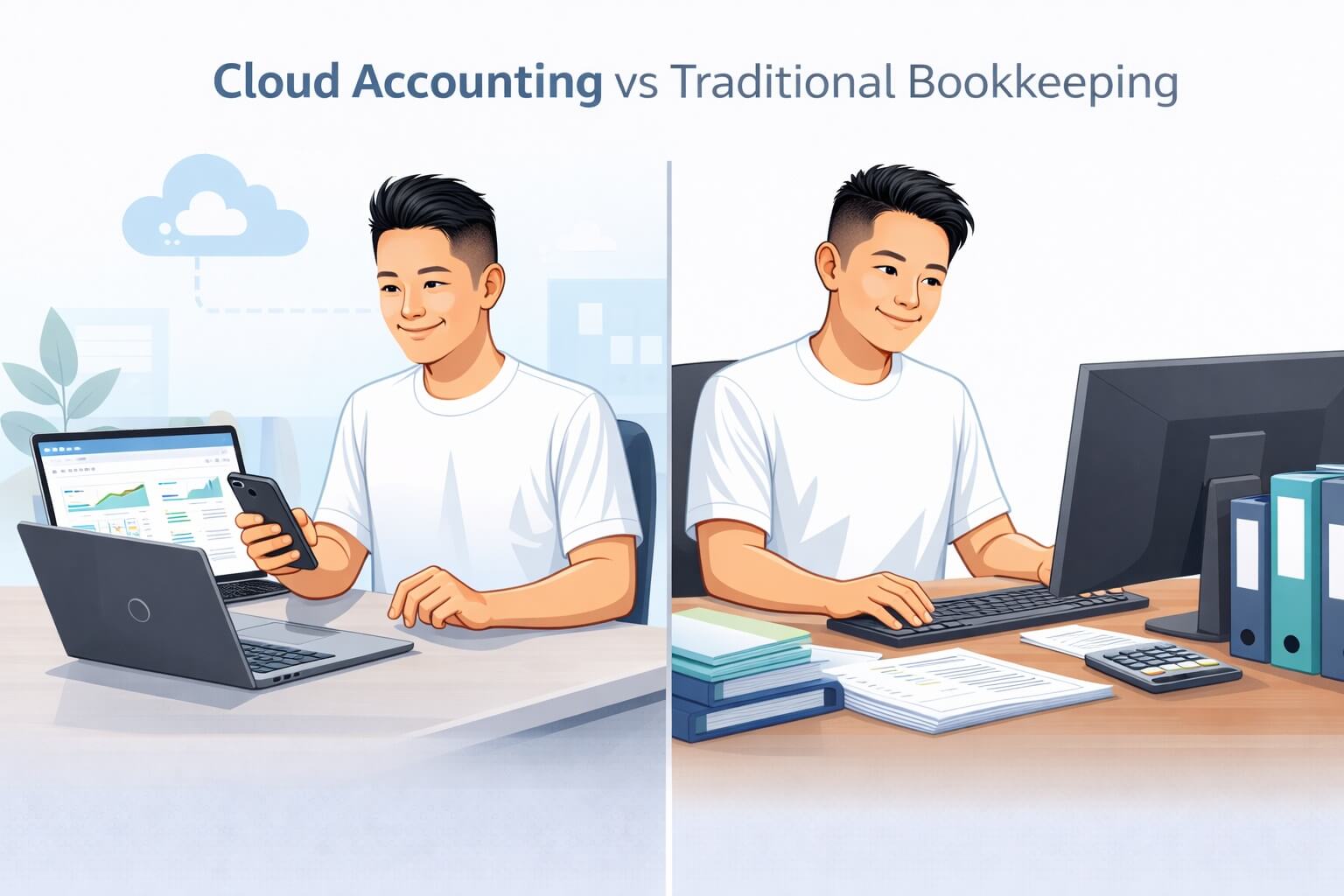
Cloud Accounting vs Traditional Bookkeeping: What Actually Makes Sense for Your Singapore Business?
Walk into any accounting conversation today and you will hear the same thing: cloud accounting is the future, everyone is moving to Xero or QuickBooks, and if your books are not on the cloud by now you are somehow behind the times.
That narrative is not wrong exactly. But it is incomplete. And for many Singapore small business owners, following it blindly has led to a situation where they are paying for software they barely use, reconciling bank feeds that do not quite work, and spending more time troubleshooting integrations than actually running their business.
The honest answer to “cloud or traditional?” is: it depends on your business, your habits, and what you actually need from your accounts. This article gives you the full picture so you can make that call with confidence.
What This Article Covers
How cloud accounting and traditional bookkeeping actually work in practice, the real pros and cons of each, the bank integration reality for Singapore businesses, which approach suits which type of business, the coming InvoiceNow requirement, and what ContactOne offers under both models.
What We Mean by Cloud Accounting and Traditional Bookkeeping
Before comparing the two, it helps to be clear about what each actually involves in the Singapore context.
Cloud Accounting
Cloud accounting means your financial records live on a remote server accessed through a web browser or app. Popular platforms in Singapore include Xero, QuickBooks Online, and a handful of local alternatives. You or your team enter transactions, upload receipts, and reconcile accounts through the platform. Your accountant or bookkeeper can access the same data in real time without anyone emailing spreadsheets back and forth.
The appeal is clear: everything is in one place, accessible from anywhere, and theoretically updated as transactions happen. Bank feeds can automatically import your transactions, reducing manual data entry. Reports can be generated at the click of a button.
Traditional Bookkeeping
Traditional bookkeeping means a qualified bookkeeper, either in-house or outsourced, maintains your financial records using dedicated accounting software installed locally or hosted privately. Your records are typically compiled from documents you provide periodically, whether monthly, quarterly, or at year-end. The bookkeeper processes everything and produces your reports, management accounts, and year-end financials.
This is not the same as keeping records in a shoebox and handing them to your accountant in December. Done properly, traditional bookkeeping is structured, timely, and produces the same outputs as cloud accounting. The difference is in who does the data entry, when it happens, and where the records sit.
The Case for Cloud Accounting
|
Advantages
|
Disadvantages
|
Cloud accounting works extremely well when the business owner is genuinely engaged with it. The keyword is genuinely. Logging in once a month to approve a batch of transactions is not the same as actively maintaining your books. The platform is only as good as the discipline of the person using it.
The Case for Traditional Bookkeeping
|
Advantages
|
Disadvantages
|
The perception that traditional bookkeeping is outdated is unfair. For a hawker supplier doing fifteen transactions a week, a tuition centre billing monthly, or a small contractor with a handful of invoices, a well-managed traditional bookkeeping arrangement is often faster, cheaper, and more reliable than a cloud platform that sits unused between accounting appointments.
The best accounting system is the one that actually gets used correctly. A neglected cloud platform is worse than a well-maintained paper trail.
The Bank Integration Reality in Singapore
This is where cloud accounting promoters often gloss over a significant practical issue, and it is worth addressing head-on.
Bank feed integration, where your cloud accounting platform automatically imports transactions from your corporate bank account, is one of the most promoted features of cloud accounting. In theory, it eliminates the need to manually enter every bank transaction. In practice, the picture in Singapore is more complicated.
What Works Well
Xero has the strongest bank integration track record in Singapore. It connects reliably with DBS and OCBC business accounts, and also integrates well with digital banking platforms like Aspire. For businesses banking with these institutions, the automated feed genuinely reduces manual work and the reconciliation process is significantly smoother.
Where Things Get Complicated
Other cloud accounting platforms available in the Singapore market have a patchier record. Some integrate reliably only with DBS, leaving businesses that bank with UOB, Standard Chartered, HSBC, or other institutions needing to import transactions manually via CSV files. This partial automation creates a hybrid workflow that is often more cumbersome than either a fully automated or fully manual approach.
Even where bank feeds are available, they are not always perfectly reliable. Feeds can disconnect when banks update their security protocols. Transactions can import with incorrect categorisations. Duplicate entries appear when a feed reconnects after a break. Each of these issues requires human intervention to clean up, and if left unattended they compound into a reconciliation problem at year-end.
Before You Commit to a Platform
Check whether your specific corporate bank account is supported by the cloud accounting software you are considering, and whether the integration is a direct API feed or a third-party connector. A direct feed is generally more stable. If your bank is not supported, factor in the time cost of manual CSV imports before deciding the platform is right for you.
The Practical Workaround
Many Singapore businesses that use cloud accounting handle bank reconciliation through a combination of automated feeds for supported banks and periodic manual imports for others. This works but it requires the business owner or their bookkeeper to stay on top of it consistently. A backlog of unreconciled transactions is one of the most common reasons cloud accounting engagements become more expensive than expected at year-end.
The Discipline Factor: Be Honest with Yourself
This is the conversation that does not happen enough when business owners are choosing an accounting approach, and it is probably the most important one.
Cloud accounting platforms are tools. Like all tools, they require the person using them to actually pick them up and use them correctly. The question is not whether Xero is good software. It is whether you will log in every week, categorise your transactions, reconcile your bank feed, and keep your records current throughout the year.
If the honest answer is no, then paying for a cloud platform subscription on top of your accountant’s fees is not a saving. It is an additional cost for a service you are not using properly. Your accountant will still need to reconstruct your records at year-end, except now they have a partially populated cloud system to untangle rather than a clean batch of source documents to work from.
Consider your track record honestly. If you have historically been good at keeping receipts, logging expenses, and responding to your accountant’s requests promptly, cloud accounting will likely suit you well. If paperwork tends to pile up and year-end is usually a scramble, a traditional bookkeeping arrangement where a professional manages your records on your behalf may produce better outcomes at lower total cost.
A Useful Test
Ask yourself how many months of bank statements you could produce within 30 minutes right now. If the answer is all of them, you probably have the discipline for cloud accounting. If the answer involves some searching, cloud accounting will likely work better with a bookkeeper doing the heavy lifting rather than you doing it yourself.
Scale and Transaction Volume: Matching the Tool to the Business
Another factor that often gets overlooked is the sheer volume of transactions your business generates. This matters because it affects both the cost and the practicality of each approach.
High Transaction Volume Businesses
Businesses with many daily transactions, such as retail outlets, food and beverage operations, e-commerce sellers, or agencies billing multiple clients monthly, typically benefit most from cloud accounting. The automation of bank feeds, the ability to bulk-categorise transactions, and the real-time reporting make cloud platforms genuinely efficient at scale. Doing this volume of work manually through traditional bookkeeping is time-consuming and expensive.
Low Transaction Volume Businesses
A freelance consultant billing three clients a month, a sole proprietor with a handful of suppliers, a small services firm with predictable recurring revenue, or a holding company with minimal operational activity, may find that cloud accounting is more infrastructure than they need. For businesses like these, the monthly subscription fee combined with the time cost of keeping the platform updated can exceed what they would pay for a traditional bookkeeping arrangement that delivers the same outcome.
Profit-Thin and Micro Businesses
This point deserves particular attention. Singapore has a large number of genuinely small businesses operating on thin margins, where every dollar of overhead matters. A cloud accounting subscription costs between $30 and $80 per month, or $360 to $960 per year, before any accountant fees. For a hawker stall owner, a home-based business, or a very small sole proprietorship, this is a meaningful cost for a tool that may offer more features than the business actually needs.
For businesses in this category, a traditional bookkeeping arrangement using a firm’s in-house software, where records are maintained by a professional and the business owner simply provides documents, is often the more economical and practical solution.
Technology Comfort Level: An Honest Assessment
Singapore’s business community spans a wide spectrum of technology comfort levels, and this is a legitimate factor in the decision, not a sign of being behind the times.
A 55-year-old owner of a third-generation wholesale business who has been successfully running the company for decades is not making a mistake by preferring a traditional bookkeeping arrangement over a cloud platform. The goal of accounting is accurate, timely financial records that support good business decisions and satisfy regulatory requirements. If traditional bookkeeping achieves that goal more reliably for a given owner, it is the right choice.
Conversely, a 30-year-old founder who manages everything else in their business through apps and online platforms will likely find cloud accounting intuitive and efficient from day one.
Technology comfort level is not fixed either. Some business owners start with traditional bookkeeping and migrate to cloud accounting once they are more established and have the bandwidth to learn a new system. This is a perfectly sensible transition path and not an admission that they should have started on the cloud from the beginning.
Side by Side: How the Two Approaches Compare
| Factor | Cloud Accounting | Traditional Bookkeeping |
|---|---|---|
| Real-time financial visibility | High, if maintained regularly | Periodic, on request |
| Requires discipline from business owner | High | Low to moderate |
| Technology comfort level needed | Moderate to high | Low |
| Bank integration (Singapore) | Works well for DBS, OCBC, Aspire via Xero.
Limited bank integration for others. |
No dependency on bank integrations |
| Monthly software cost | $30 to $80 per month | None to business owner |
| Suited for high transaction volume | Yes | Less so above a certain volume |
| Suited for micro and profit-thin businesses | Only if owner maintains it actively | Often more cost-effective |
| Year-end accounting cost if records well-maintained | Lower | Lower |
| Year-end accounting cost if records poorly maintained | Higher (cleanup required) | Moderate |
| InvoiceNow readiness (GST-registered companies) | Generally supported | Depends on software used |
Which Type of Business Suits Which Approach?
|
E-commerce or retail with many daily transactions Cloud Accounting High volume and the need for real-time inventory and sales data makes cloud platforms genuinely valuable. Xero integrates with platforms like Shopify and Stripe, reducing double-entry work significantly. |
Agency, consultancy, or professional services firm Cloud Accounting Multiple client invoices, project-based billing, and the need to track receivables in real time suits cloud accounting well, especially for owners comfortable with technology. |
|
Small contractor or sole proprietor with few invoices Traditional Bookkeeping Low transaction volume means the automation benefits of cloud accounting are minimal. A traditional arrangement is often cheaper and requires no ongoing platform management from the owner. |
F&B, retail, or trading with non-major bank account Traditional or Hybrid If your corporate account is not with DBS, OCBC, or a platform like Aspire, bank feed integrations may be unreliable. Factor in manual reconciliation time before committing to cloud accounting. |
|
Business owner with low technology comfort Traditional Bookkeeping A fully managed bookkeeping arrangement removes the burden of platform management entirely. You provide documents; your bookkeeper handles the rest. Straightforward and reliable. |
Fast-growing startup or company planning to fundraise Cloud Accounting Investors and due diligence teams expect clean, accessible, real-time financial records. Cloud accounting makes the reporting process significantly smoother during fundraising rounds. |